Published by VibePi | Interview Preparation | 12 min read
There's a moment at the start of almost every job interview that catches people off guard, not because it's difficult, but because it sounds so easy.
"So, tell me about yourself."
You've prepared for the tough questions. You've rehearsed how you'd handle the curveball about your biggest weakness. You've thought through your five-year plan. And then the interviewer opens with this, and suddenly you're not sure whether to start from your A-levels, your last job, or somewhere in the middle. You're not sure how long to talk. You're not sure how personal to get.
Most people stumble through it. They either speed-read their CV back at the interviewer or go so broad that they say nothing memorable at all.
This guide will fix that. By the end, you'll have a clear structure, real examples for different career stages, and crucially, a way to practise that actually prepares you for the moment itself.
Why this question matters more than it seems
Jeremy Schifeling, a former career adviser and principal product marketing manager at Khan Academy, put it bluntly: "What seems like a throwaway question to both hiring managers and job interviewees is actually the exact opposite. It's probably the most important question in the entire conversation."
Here's why. Research from The Muse suggests that hiring decisions are often heavily shaped within the first minute of an interview. Your answer to "tell me about yourself" is that first minute. It sets the frame. It programmes what comes next. If you emphasise your analytical background early, you'll likely get follow-up questions about data and problem-solving. If you lead with leadership, expect behavioural questions about managing people.
You're essentially choosing the direction of the interview with your opening answer. Most candidates don't realise this, and most candidates treat the question as an invitation to recap their CV from 2019 onwards.
The interviewer has already read your CV. What they're actually listening for is something different: how you prioritise information, how clearly you communicate under low pressure (with harder questions coming later), and whether your professional story connects logically to the role in front of them.
As Robert Half puts it, hiring managers want to understand "what experience and qualifications you think are most relevant to the position." That's a very different ask from "walk me through everything you've done."
The one thing most people get wrong
Before we get to structure, let's deal with the most common mistake.
Most people treat this question as a pitch. The moment they hear "tell me about yourself," they switch into sales mode, listing achievements, stacking adjectives, front-loading every impressive thing they've ever done. You can almost hear the rehearsal in their voice.
The problem is that this is an icebreaker, not a courtroom argument. One experienced recruiter described it this way: "They're not hoping you'll sell yourself like it's Dragon's Den. They're just trying to ease into the conversation. Help you settle. See how you communicate when there's no pressure. It's not about proving yourself. It's about connection."
The second most common mistake is going too long. There's no formal rule, but career coaches and hiring managers consistently point to the same range: 60 to 90 seconds. That's roughly 150 to 225 words spoken aloud. If you're going past two minutes, you're rambling, and the interviewer is mentally checking out, or worse, forming an impression about your ability to be concise.
The framework that actually works: Present, Past, Future
The most reliable structure for answering this question is known as the Present -Past - Future framework. It was developed by Lily Zhang, Manager of Graduate Student Professional Development at the MIT Media Lab, and has since been taught at MIT, Stanford, Harvard Career Services, and countless coaching programmes worldwide. There's a reason it's survived, it works.
Here's the skeleton:
Present - Who are you right now, professionally? What are you doing, and what have you achieved recently?
Past - What 2–3 experiences from your background are most relevant to this role? Not your whole history. A highlight reel.
Future - What are you looking for next, and why does this specific role/company match that?
The key insight is that most people answer chronologically, starting from the beginning and working forward. The PPF framework flips this. You lead with the present, because that's the most relevant thing the interviewer wants to know. You reach backwards only far enough to give it context. Then you pivot forward to land the answer on them.
It sounds structured because it is, but when it's delivered naturally, it doesn't feel rehearsed. It feels like someone who knows their own professional story.
What it sounds like in practice
Here are four examples across different career stages. Notice how each one follows the PPF structure but sounds distinct — because the details are real, not generic.
Example 1: Mid-level professional
"I'm currently a digital marketing manager at a mid-size fintech company, where I look after paid acquisition and content strategy. Over the past 18 months I've grown our inbound leads by around 40% while cutting cost-per-acquisition by a third — mostly through better audience targeting and tightening up our landing pages. Before that, I spent three years at a startup where I was genuinely a team of one, which taught me a lot about making good decisions quickly with limited resources. I'm at a point in my career where I want to work somewhere with more cross-functional scale — which is why this role stood out. The combination of the growth stage you're at and the size of the marketing team here feels like exactly the right next step."
What makes it work: Opens with a clear current role, immediately backs it up with a real number, selects only one prior experience and draws a genuine lesson from it, then pivots to a specific reason for being there. It takes about 75 seconds.
Example 2: Recent graduate with no full-time experience
"I graduated last year with a degree in psychology, which gave me a strong grounding in how people make decisions, something I've realised I want to build a career around. During my final year I did a placement at a market research agency, where I helped run focus groups and analysed consumer data for three different client projects. One of those was a product launch study I presented directly to the client, which I didn't expect to enjoy as much as I did. Since graduating I've been doing some freelance survey work while job searching, so I've kept busy and kept learning. This role appeals because it brings together the research rigour I've trained in and the client-facing element I discovered I was drawn to."
What makes it work: No experience isn't a disadvantage when you frame what you did do with clear specificity. Notice this candidate doesn't apologise for limited experience, they just focus on what's relevant.
Example 3: Career changer
"I've spent eight years in primary school teaching, which on paper might seem like a different world, but the core of what I did every day was take complex information and make it accessible to people who were new to it. That's a skill that transfers. I've recently completed a project management certification and spent the last six months volunteering as a project coordinator for a local charity, where I managed four cross-functional workstreams simultaneously. I've been deliberate about this change rather than just looking for the nearest exit from teaching, and this role is genuinely the first one I've seen that combines the structured planning I've trained for with work that still has a clear human impact."
What makes it work: Career changers need to do one thing above all else, build a bridge. This answer does that explicitly, naming the transferable skill upfront and then demonstrating evidence of the new direction, not just intention.
Example 4: Senior professional
"I've spent the last decade in product leadership, most recently as VP of Product at a Series B SaaS company, where I took us from 12 engineers and no roadmap structure to a 60-person product and engineering organisation shipping on a quarterly cadence. Before that I was at two earlier-stage companies, so I've done the zero-to-one work and the scaling work. At this point in my career I'm specifically looking for a role where I can shape product culture from the top rather than execute within someone else's vision. The reason I reached out about this one is your approach to embedded product teams, it's the model I believe in, and I'd rather build on something I'm already convinced by."
What makes it work: Senior candidates don't need to establish credibility, they need to establish specificity. The detail about "the model I already believe in" tells the interviewer this person has done their homework and has opinions, not just experience.
Adapting the structure for different situations
The PPF framework is flexible. A few variations worth knowing:
For phone screens: Compress to 45 - 60 seconds. Phone screens are often with a recruiter rather than the hiring manager, so the goal is simpler — qualify yourself and create interest, not win the job in two minutes.
For internal interviews (applying for a promotion): Your "present" is already known. Lean heavily on the "future" what you want to take on next and why you believe you're ready. The risk with internal candidates is being too comfortable and not selling themselves; you still need to make the case.
For video interviews: The absence of natural physical cues (handshake, walking to your seat) means you have less transition time to settle before the question lands. Have your first sentence ready before you log on. The first few words set your tone. if you start strong, you'll feel the rhythm come.
Mistakes that will hurt you
Summarising your entire CV: They've read it. This wastes the question.
Starting with "I was born in..." or "I've always been passionate about..." : Unless you are a charismatic storyteller (most people aren't, under pressure), opening with personal backstory burns time before you get to what the interviewer actually wants to know.
Saying you're "a hard worker" or "a team player" : These phrases have been in every interview answer for 30 years. They register as white noise. Replace them with a specific, and let the specific imply the quality.
Going negative about a current or former employer: Even in passing. Even if it's true. It raises a flag about how you'll speak about this company if you leave.
Ending without connecting to the role : The "Future" part of the framework is not optional. An answer that stops at your last job sounds like someone reading from a script. An answer that lands on "which is why this opportunity is interesting" sounds like someone who actually wants the job.
The part nobody talks about: you have to say it out loud
Here's something that almost every piece of interview advice gets wrong. People read frameworks like this one, nod along, draft something on paper, and feel prepared. Then they sit in the interview, the question comes, and what they rehearsed in their head sounds completely different when it leaves their mouth.
There's a reason for this. Reading something and saying it out loud activate different parts of the brain, those responsible for speech, breathing, real-time self-monitoring, and managing nerves. Silent rehearsal develops exactly none of those things. Actors don't just read their scripts. They rehearse them, out loud, repeatedly, until the delivery becomes natural and the lines stop feeling like lines.
The same applies here. The discomfort of hearing yourself say something for the first time is best experienced before the interview, not during it. If you've said "I'm currently a product manager at..." out loud twenty times, the twenty-first time - in the actual room - will flow. If you've only ever thought it, it won't.
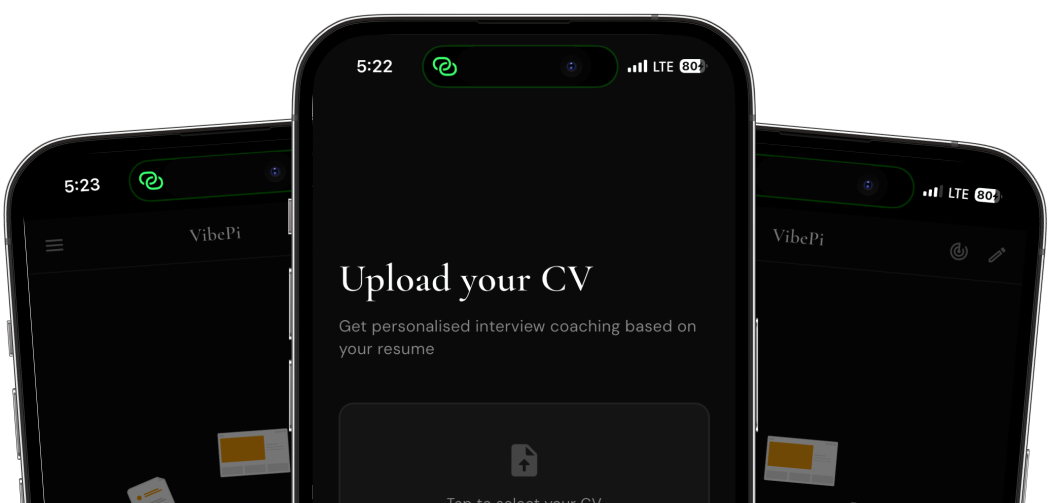
There are several ways to practise. You can record yourself on your phone, which is genuinely useful because most people are surprised by how different they sound versus how they sound in their head. You can ask a friend to play interviewer, which adds the social pressure element. Or you can use a voice-practice tool like VibePi, which simulates the live interview environment, transcribes your answers, and gives you feedback on your delivery — so you're not relying on someone else's availability or patience.
The method matters less than the fact of doing it aloud. Do it until the answer sounds natural, not rehearsed.
A quick checklist before your interview
Use this in the 24 hours before:
- [ ] Is my answer 60–90 seconds? (Time yourself out loud)
- [ ] Does my "Present" open with something concrete, a role, a recent achievement, or a specific result?
- [ ] Have I chosen only 2 to 3 past experiences, not a full career history?
- [ ] Does my "Future" mention this specific company or role, not just "a company like yours"?
- [ ] Have I removed every generic adjective (hard-working, passionate, team player) and replaced it with something specific?
- [ ] Have I said the whole thing out loud at least five times?
If you can tick all six, you're in better shape than most people who will interview that day.
Variations of the question to prepare for
"Tell me about yourself" doesn't always arrive in those exact words. Be ready for:
- "Walk me through your background"
- "Take me through your CV"
- "Tell me about your career journey"
- "Describe yourself"
- "Tell me something that's not on your resume"
The last one is interesting because it's genuinely open-ended, the interviewer often wants a glimpse of personality, not just professional history. For this variant, a brief personal interest or value that connects back to the work is usually the right move. Not a hobby for its own sake, but one that says something about how you think or what you care about.
One last thought
The reason "tell me about yourself" catches people off guard is that it sounds informal but isn't. It's asking you to compress a complex, ongoing professional story into 90 seconds in a way that sounds natural, positions you well, and lands on why you're sitting in that chair.
That's actually hard. But it's the kind of hard thing that responds extremely well to preparation, specifically to the kind of preparation where you say it out loud, hear where it falls apart, and refine it.
Most of your competition will walk into the interview having read a few sample answers. If you've actually practised speaking yours, you'll already be ahead.
Want to practise your answer out loud before your next interview? VibePi gives you a real AI interviewer to speak to. it asks the question, listens to your answer, and gives you instant feedback on what's working and what to tighten up. Download VibePi free on iOS and Android.
Related reading:
- What are your greatest strengths and weaknesses? (Best interview answers)
- Good questions to ask at the end of a job interview
- How to use the STAR method for behavioural interview questions
- How to prepare for a job interview in one week: a day-by-day plan